


Demand Response

in Singapore

Earn from grid flexibility without disrupting operations

Earn from grid flexibility without
disrupting operations

Published by

Blue Whale Energy

Reading time

~8 minutes

Last updated

May 2026

Last updated

May 2026

A 30-minute spike can create a week of value

One volatile week in Singapore's power market

Most Demand Response value does not come from reducing power all day. It comes from being ready when the grid is tight and wholesale prices spike.

In Singapore, eligible large electricity consumers can offer verified reductions in grid import into the wholesale electricity market. ¹ When those reductions help lower wholesale prices, participating sites can receive a share of the savings created.

For many C&I sites, that reduction does not have to mean switching off operations. A behind-the-meter battery can reduce grid import while the site continues running.

$700

$700

$700

$700

$700

M+

M+

M+

M+

M+

Market-wide savings delivered

Market-wide savings delivered

Market-wide savings delivered

Market-wide savings delivered

30

30

30

30

30

MIN

MIN

MIN

MIN

MIN

Per DR period

Per DR period

Per DR period

Per DR period

~5

~5

~5

~5

~5

%

%

%

%

%

Of half-hour intervals

Of half-hour intervals

Of half-hour intervals

Of half-hour intervals

$297

$297

$297

$297

$297

/MWh, DR activation threshold

/MWh, DR activation threshold

/MWh, DR activation threshold

/MWh, DR activation threshold

/MWh, DR activation threshold

$1

$1

$1

$1

$1

150

150

150

150

150

/ MWh, Peak half-hour USEP on 19 Feb

/ MWh, Peak half-hour USEP on 19 Feb

/ MWh, Peak half-hour USEP on 19 Feb

01

01

01

What is 
Demand Response?

Demand Response rewards eligible businesses for reducing grid import when the power system needs flexibility.

Singapore’s electricity system has to keep supply and demand balanced in real time. When demand rises, the system can either bring on more generation or reduce demand from large electricity users.

Demand Response creates a market for that second option.

Eligible businesses commit to reducing how much electricity they draw from the grid during selected periods. When they are activated, deliver the reduction, and the reduction is verified, they can receive incentive payments.

There are three main ways a site can reduce grid demand. Two involve changing how the site operates. The third changes where the site gets its power from.


Manual curtailment

Temporarily turn down or switch off non-critical equipment, such as lighting, secondary HVAC, pumps, or redundant systems.

Manual curtailment

Temporarily turn down or switch off non-critical equipment, such as lighting, secondary HVAC, pumps, or redundant systems.

Manual curtailment

Temporarily turn down or switch off non-critical equipment, such as lighting, secondary HVAC, pumps, or redundant systems.

Manual curtailment

Temporarily turn down or switch off non-critical equipment, such as lighting, secondary HVAC, pumps, or redundant systems.

Operational shifting

Move flexible electricity use away from peak periods, such as batch production, pre-cooling, or equipment charging windows.

Operational shifting

Move flexible electricity use away from peak periods, such as batch production, pre-cooling, or equipment charging windows.

Operational shifting

Move flexible electricity use away from peak periods, such as batch production, pre-cooling, or equipment charging windows.

Operational shifting

Move flexible electricity use away from peak periods, such as batch production, pre-cooling, or equipment charging windows.

Asset-backed reduction

Use a battery or other on-site energy asset to supply the site, reducing grid import.

Asset-backed reduction

Use a battery or other on-site energy asset to supply the site, reducing grid import.

Asset-backed reduction

Use a battery or other on-site energy asset to supply the site, reducing grid import.

Battery-backed reduction

Use an on-site battery to supply part of the site’s load, reducing grid import while equipment continues running.

Asset-backed reduction

Use a battery or other on-site energy asset to supply the site, reducing grid import.

Behavioural and operational DR ask the site to change what it does. Asset-backed DR changes where the site gets its power from.

Operational Demand Response changes what the site does.
Battery-backed Demand Response changes where the site gets its power from.

The battery supplies part of the load behind the meter; equipment keeps running.

In both cases, the market sees a verified reduction in grid import.

Demand Response pays for timing,  not general conservation.
Energy efficiency lowers total electricity use over time.
Demand Response is different. It rewards eligible sites for reducing grid import during short, high-value market intervals - when Singapore’s power system would otherwise need more expensive supply.
That reduction can come from changing operations, or from a battery supplying part of the site’s load behind the meter. reduces total consumption over time. Demand Response reduces grid draw during specific market intervals. The value comes from reducing demand at the exact moment the market would otherwise need more expensive supply.
Demand Response pays for timing,  not general conservation.
Energy efficiency lowers total electricity use over time.
Demand Response is different. It rewards eligible sites for reducing grid import during short, high-value market intervals - when Singapore’s power system would otherwise need more expensive supply.
That reduction can come from changing operations, or from a battery supplying part of the site’s load behind the meter. reduces total consumption over time. Demand Response reduces grid draw during specific market intervals. The value comes from reducing demand at the exact moment the market would otherwise need more expensive supply.
Demand Response pays for timing,  not general conservation.
Energy efficiency lowers total electricity use over time.
Demand Response is different. It rewards eligible sites for reducing grid import during short, high-value market intervals - when Singapore’s power system would otherwise need more expensive supply.
That reduction can come from changing operations, or from a battery supplying part of the site’s load behind the meter. reduces total consumption over time. Demand Response reduces grid draw during specific market intervals. The value comes from reducing demand at the exact moment the market would otherwise need more expensive supply.
Demand Response is about timing, not using less power all day.
Energy efficiency lowers total electricity use over time.
Demand Response is different. It rewards eligible sites for reducing grid import during short, high-value market intervals - when Singapore’s power system would otherwise need more expensive supply.
That reduction can come from changing operations, or from a battery supplying part of the site’s load behind the meter.

02

02

02

When does
Demand Response create value?

Demand Response is most valuable when the power system is under pressure.

Most of the time, Singapore’s wholesale electricity price is relatively steady. Demand can be met by lower-cost generation, so there is less need for flexibility from large electricity users.

But during certain periods, the system can become tighter. Demand may rise, available supply may fall, or a generator may unexpectedly trip offline.

When that happens, the market may need more expensive supply to keep the system balanced. Prices can move sharply during those intervals.

Demand Response is built for these moments. If an eligible site can reduce verified grid import at the right time, that reduction can help lower demand on the system - and create settlement value.

Because Singapore’s wholesale market is settled in half-hourly intervals, even a short reduction can matter.

High demand

Hot afternoons, evening peaks, or periods of heavy cooling load can push the grid closer to capacity.

High demand

Hot afternoons, evening peaks, or periods of heavy cooling load can push the grid closer to capacity.

High demand

Hot afternoons, evening peaks, or periods of heavy cooling load can push the grid closer to capacity.

High demand

Hot afternoons, evening peaks, or periods of heavy cooling load can push the grid closer to capacity.

Tight reserves

When fewer generators are available, the system may need to call on more expensive supply.

Tight reserves

When fewer generators are available, the system may need to call on more expensive supply.

Tight reserves

When fewer generators are available, the system may need to call on more expensive supply.

Tight reserves

When fewer generators are available, the system may need to call on more expensive supply.

Generation outage

If a generator trips offline, other plants must cover the gap quickly.

Generation outage

If a generator trips offline, other plants must cover the gap quickly.

Generation outage

If a generator trips offline, other plants must cover the gap quickly.

Generation outage

If a generator trips offline, other plants must cover the gap quickly.

USEP · Uniform Singapore Energy Price — The half-hourly wholesale price all generators receive. VCP · Vesting Contract Price — The regulated reference price; quoted quarterly by EMA

~

~

~

~

0
0
0
0

%

%

%

%

USEP Price Duration Curve

USEP Price Duration Curve

Top intervals where DR value is concentrated

Top intervals where DR value is concentrated

Top intervals where DR value is concentrated

Top intervals where DR value is concentrated

Most of the year sits in this flat tail

Top ~5% of intervals

Most of the year sits in this flat tail

Top ~5% of intervals

0

0

1,500

1,500

3,000

3,000

4,500

4,500

USEP and System Demand · Mon 16 Feb to Sun 22 Feb 2026

USEP and System Demand · Mon 16 Feb to Sun 22 Feb 2026

USEP and System Demand · Mon 16 Feb to Sun 22 Feb 2026

For most half-hour intervals, the price stays low. But on Thursday 19 February at 14:30, it spiked to $1,150 - and the entire grid paid that price for one 30-minute window.

For most half-hour intervals, the price stays low. But on Thursday 19 February at 14:30, it spiked to $1,150 - and the entire grid paid that price for one 30-minute window.

Price ($/MWh)

Price ($/MWh)

Example  ·  One High-volatility Week

Example  ·  One High-volatility Week

Demand (MW)

Demand (MW)

Spikes

Spikes

VCP $186 (Q1 2026)

VCP $186 (Q1 2026)

VCP $186 (Q1 2026)

VCP $186 (Q1 2026)

VCP $186 (Q1 2026)

Thu 19 Feb · 14:30–15:00

Thu 19 Feb · 14:30–15:00

Thu 19 Feb · 14:30–15:00

USEP:

USEP:

USEP:

S$

S$

S$

900
900
900
900

Demand: 6963 MW · VCP: S$186

Demand: 6963 MW · VCP: S$186

Demand: 6963 MW · VCP: S$186

MON 16

MON 16

MON 16

MON 16

TUE 17

TUE 17

TUE 17

TUE 17

WED 18

WED 18

WED 18

WED 18

THU 19

THU 19

THU 19

THU 19

FRI 20

FRI 20

FRI 20

FRI 20

SAT 21

SAT 21

SAT 21

SAT 21

SUN 22

SUN 22

SUN 22

SUN 22

1,200

1,200

1,200

1,000

1,000

1,000

800

800

800

600

600

600

400

400

400

200

200

200

0

0

0

8,000

8,000

8,000

7,000

7,000

7,000

6,000

6,000

6,000

5,000

5,000

5,000

Why can a small reduction create so much value?
Because wholesale prices are set by the last, most expensive supply needed to meet demand.
When Demand Response reduces grid import at the right moment, the market may avoid calling on that next expensive plant.
The next section explains how that price is set, plant by plant.
Why can a small reduction create so much value?
Because wholesale prices are set by the last, most expensive supply needed to meet demand.
When Demand Response reduces grid import at the right moment, the market may avoid calling on that next expensive plant.
The next section explains how that price is set, plant by plant.
Why can a small reduction create so much value?
Because wholesale prices are set by the last, most expensive supply needed to meet demand.
When Demand Response reduces grid import at the right moment, the market may avoid calling on that next expensive plant.
The next section explains how that price is set, plant by plant.

03

03

03

How is the price set?

The last unit of supply needed sets the market price.

Singapore’s wholesale electricity market works by matching demand with available supply for each market interval.

Lower-priced supply is used first. If demand is higher, the market has to call on more expensive supply. The final plant needed to meet demand is called the marginal plant - and its offer sets the clearing price for that interval.

That is why Demand Response can create value.

If an eligible site reduces grid import at the right moment, the market may no longer need the next expensive plant. The interval can clear at a lower price, reducing wholesale costs. Successful Demand Response participants receive a share of the savings created by that price reduction.

Lower-cost supply first

The market starts with the lowest-priced available supply, then adds more expensive supply as demand rises.

Lower-cost supply first

The market starts with the lowest-priced available supply, then adds more expensive supply as demand rises.

Lower-cost supply first

The market starts with the lowest-priced available supply, then adds more expensive supply as demand rises.

Lower-cost supply first

The market starts with the lowest-priced available supply, then adds more expensive supply as demand rises.

The marginal plant sets the price

The final plant needed to meet demand sets the clearing price for that market interval.

The marginal plant sets the price

The final plant needed to meet demand sets the clearing price for that market interval.

The marginal plant sets the price

The final plant needed to meet demand sets the clearing price for that market interval.

The marginal plant sets the price

The final plant needed to meet demand sets the clearing price for that market interval.

One price for the interval

Under the uniform clearing price, scheduled supply is settled at the market clearing price, not each plant’s individual offer.

One price for the interval

Under the uniform clearing price, scheduled supply is settled at the market clearing price, not each plant’s individual offer.

One price for the interval

Under the uniform clearing price, scheduled supply is settled at the market clearing price, not each plant’s individual offer.

One price for the interval

Under the uniform clearing price, scheduled supply is settled at the market clearing price, not each plant’s individual offer.

How a reduction changes the clearing price

This simplified supply stack shows one market interval.

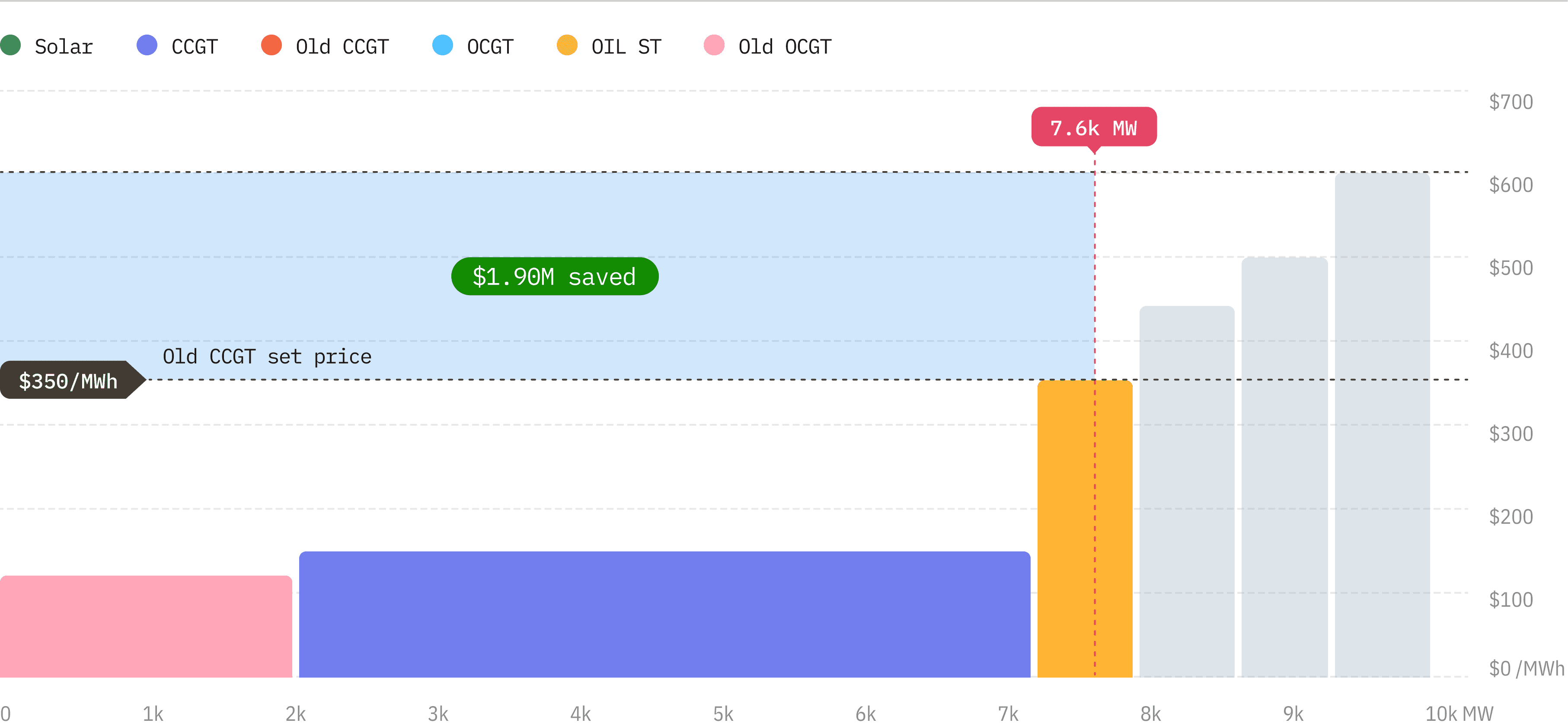
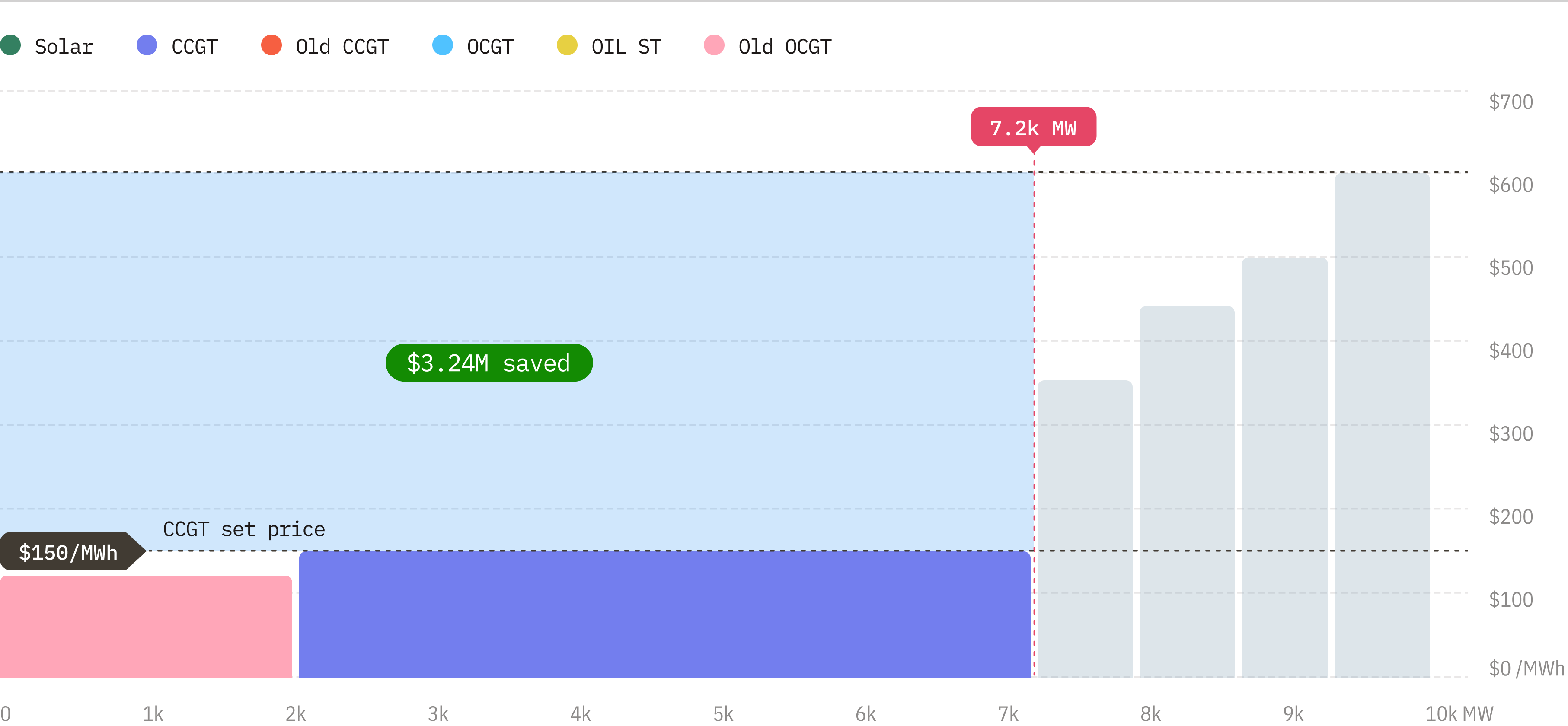
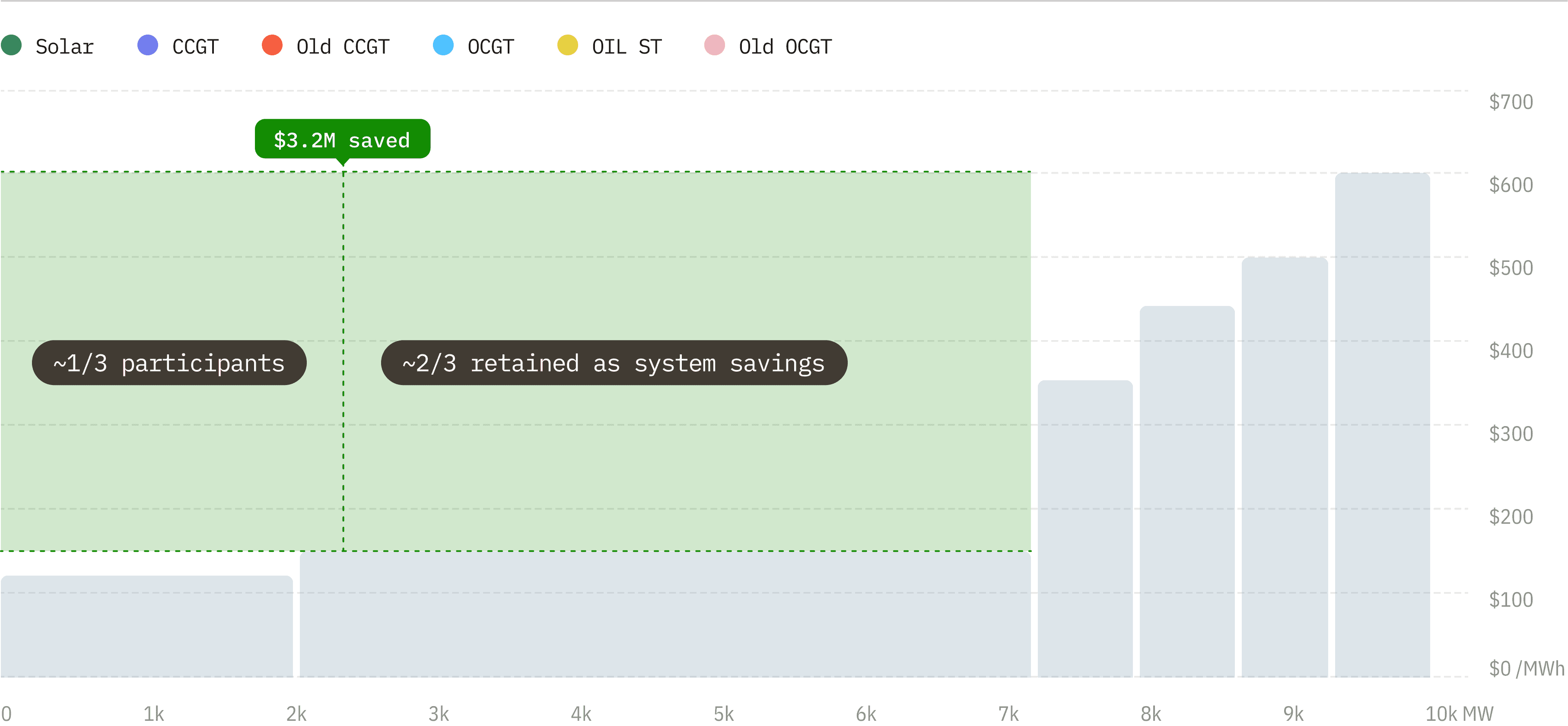
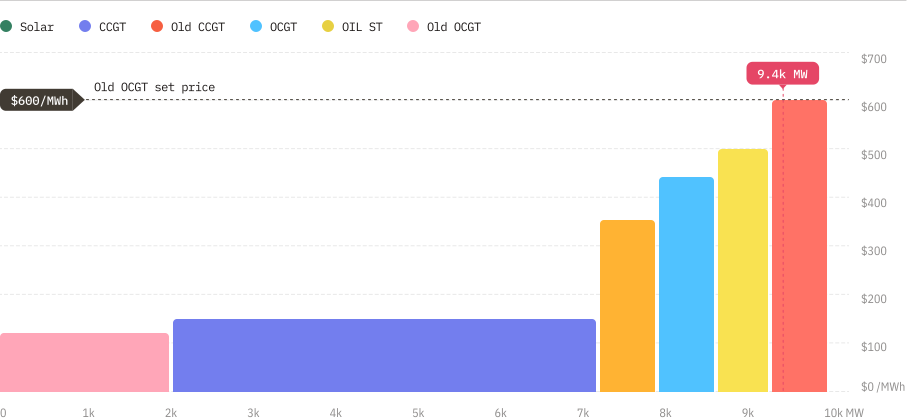
Available supply is stacked from lower-priced to higher-priced generation. Scroll through to see how a verified Demand Response reduction can lower grid import, change the marginal plant, and reduce the clearing price.
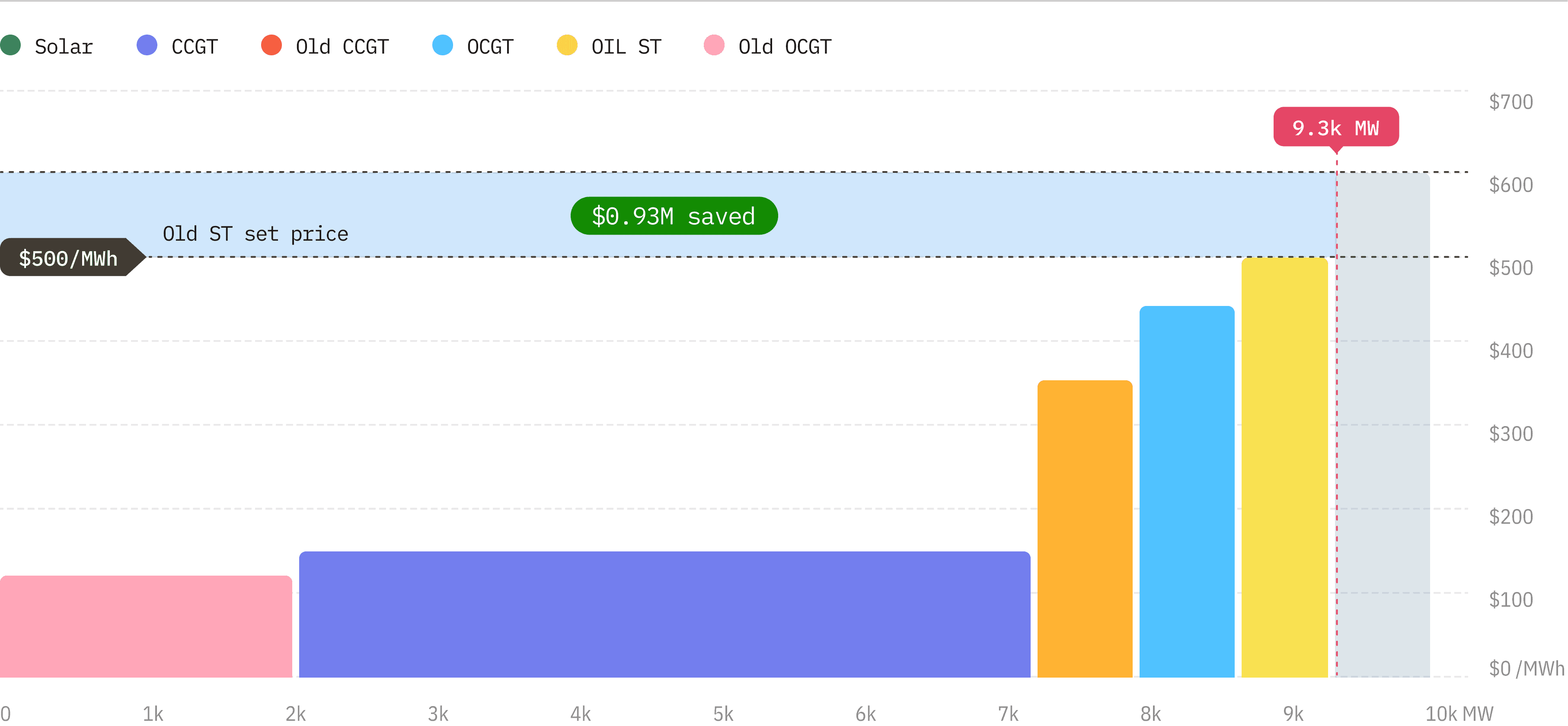
Before DR

Demand falls

Marginal plant out

Clearing price falls

Savings allocated

The most expensive plant sets the price.

With no Demand Response, the market has to use an expensive peaking plant to meet the last part of demand. That plant is the marginal unit, so it sets the clearing price for the interval. In this example, the interval clears at S$600/MWh.

Wholesale price

per MWh

S$600

Grid cost

per hour

S$5.64

M

Savings

per hour

S$0

M

Demand reduced

in MW

0

Before DR

The most expensive plant sets the price.

With no Demand Response, the market has to use an expensive peaking plant to meet the last part of demand. That plant is the marginal unit, so it sets the clearing price for the interval. In this example, the interval clears at S$600/MWh.

Wholesale price

per MWh

S$600

Grid cost

per hour

S$5.64

M

Savings

per hour

S$0

M

Demand reduced

in MW

0

Before DR

The most expensive plant sets the price.

With no Demand Response, the market has to use an expensive peaking plant to meet the last part of demand. That plant is the marginal unit, so it sets the clearing price for the interval. In this example, the interval clears at S$600/MWh.

Wholesale price

per MWh

S$600

Grid cost

per hour

S$5.64

M

Savings

per hour

S$0

M

Demand reduced

in MW

0

Before DR

Demand falls

Marginal plant out

Clearing price falls

Savings allocated

The most expensive plant sets the price.

With no Demand Response, the market has to use an expensive peaking plant to meet the last part of demand. That plant is the marginal unit, so it sets the clearing price for the interval. In this example, the interval clears at S$600/MWh.

Wholesale price

per MWh

S$600

Grid cost

per hour

S$5.64

M

Savings

per hour

S$0

M

Demand reduced

in MW

0

Before DR

Demand falls

Marginal plant out

Clearing price falls

Savings allocated

The most expensive plant sets the price.

With no Demand Response, the market has to use an expensive peaking plant to meet the last part of demand. That plant is the marginal unit, so it sets the clearing price for the interval. In this example, the interval clears at S$600/MWh.

Wholesale price

per MWh

S$600

Grid cost

per hour

S$5.64

M

Savings

per hour

S$0

M

Demand reduced

in MW

0

Demand falls

Demand Response lowers grid import.

An eligible site reduces verified grid import during the interval. On the market side, total demand falls. The system now needs less supply to meet the same interval.

Wholesale price

per MWh

S$100

S$500

Grid cost

per hour

S$4.65

M

Savings

per hour

S$0.93

M

Demand reduced

in MW

200

Demand falls

Demand Response lowers grid import.

An eligible site reduces verified grid import during the interval. On the market side, total demand falls. The system now needs less supply to meet the same interval.

Wholesale price

per MWh

S$100

S$500

Grid cost

per hour

S$4.65

M

Savings

per hour

S$0.93

M

Demand reduced

in MW

200

Marginal plant out

The expensive plant is no longer needed.

Once demand falls far enough, the market can meet demand without the highest-priced plant. The next plant down the stack becomes the new marginal unit. That is the point where a reduction starts to affect the market clearing price.

Wholesale price

per MWh

S$150

S$350

Grid cost

per hour

S$2.66

M

Savings

per hour

S$1.90

M

Demand reduced

in MW

1,800

Marginal plant out

The expensive plant is no longer needed.

Once demand falls far enough, the market can meet demand without the highest-priced plant. The next plant down the stack becomes the new marginal unit. That is the point where a reduction starts to affect the market clearing price.

Wholesale price

per MWh

S$150

S$350

Grid cost

per hour

S$2.66

M

Savings

per hour

S$1.90

M

Demand reduced

in MW

1,800

Clearing price falls

The whole interval clears at a lower price.

Because the marginal plant has changed, the clearing price falls for the interval. The value created is not just the electricity one site avoided drawing from the grid. It comes from the lower wholesale price across the market interval.

Wholesale price

per MWh

S$200

S$150

Grid cost

per hour

S$1.08

M

Savings

per hour

S$3.24

M

Demand reduced

in MW

2,200

Clearing price falls

The whole interval clears at a lower price.

Because the marginal plant has changed, the clearing price falls for the interval. The value created is not just the electricity one site avoided drawing from the grid. It comes from the lower wholesale price across the market interval.

Wholesale price

per MWh

S$200

S$150

Grid cost

per hour

S$1.08

M

Savings

per hour

S$3.24

M

Demand reduced

in MW

2,200

Savings allocated

The savings are shared.

The lower clearing price creates wholesale market savings. Under the Demand Response mechanism, successful participants receive a share of the calculated savings for their verified reduction. The remaining savings stay in the market as lower wholesale costs for electricity buyers.

Wholesale price

per MWh

$200

S$150

Grid cost

per hour

S$1.08

M

Savings

per hour

S$3.24

M

Demand reduced

in MW

2,200

Savings allocated

The savings are shared.

The lower clearing price creates wholesale market savings. Under the Demand Response mechanism, successful participants receive a share of the calculated savings for their verified reduction. The remaining savings stay in the market as lower wholesale costs for electricity buyers.

Wholesale price

per MWh

$200

S$150

Grid cost

per hour

S$1.08

M

Savings

per hour

S$3.24

M

Demand reduced

in MW

2,200

04

04

04

Where do the savings go?

Successful Demand Response participants receive one-third of the savings they help create.

When Demand Response lowers the market clearing price, it creates savings across the wholesale market interval.

Those savings are split in two ways.

Successful participants receive one-third of the calculated price-reduction savings, based on the verified reduction they delivered.

The remaining two-thirds stays in the wholesale market through the lower clearing price, reducing costs for electricity buyers.

This is what makes Demand Response different from a grant or subsidy. Participants are paid because their reduction helps create savings for the wider market. ³

Participant Incentive

Participant Incentive

Participant Incentive

Participant Incentive

Paid to successful DR participants for verified reductions that help lower the clearing price.

Paid to successful DR participants for verified reductions that help lower the clearing price.

Paid to successful DR participants for verified reductions that help lower the clearing price.

Paid to successful DR participants for verified reductions that help lower the clearing price.

1/3

1/3

1/3

Participant Incentive

Paid to successful DR participants for verified reductions that help lower the clearing price.

1/3

Market-wide savings

Market-wide savings

Market-wide savings

Market-wide savings

Retained in the wholesale market through the lower clearing price.

Retained in the wholesale market through the lower clearing price.

Retained in the wholesale market through the lower clearing price.

Retained in the wholesale market through the lower clearing price.

2/3

2/3

2/3

Market-wide
savings

Retained in the wholesale market through the lower clearing price.

2/3

Participant incentive

Paid to successful DR participants whose verified reductions helped lower the market price.

Market-wide savings

Passed through the wholesale market through a lower clearing price, benefiting electricity buyers.

The split matters because DR is performance-based. A site is not paid simply for having a battery or reducing load. It is paid when its verified reduction helps lower the market price.

05

05

05

Is this real in Singapore?

Yes. Demand Response has already delivered measurable wholesale market savings.

Demand Response is not just a policy idea. It is already part of Singapore’s wholesale electricity market.

Between 2023 and mid-2024, Demand Response helped deliver more than S$700 million in wholesale market savings to electricity buyers through lower clearing prices.

That figure is market-wide savings - not individual participant revenue. Demand Response participants are paid when their verified reductions help lower the market price and create savings for the system.

Cumulative market-wide wholesale savings

Cumulative market-wide wholesale savings

S$

S$

S$

S$

M+

M+

M+

M+

Programme growth · 2018 → 2025

Programme growth · 2018 → 2025

Demand Response is becoming a real flexibility market in Singapore.

Early participation was limited because many sites had to change operations or curtail load to respond.

That changed when eligible battery storage entered the programme. Batteries can reduce grid import behind the meter, making Demand Response practical for more C&I sites.

Enrolled DR capacity rose from 7 MW in 2018 to 167 MW by 2025, with more than 400 MW of commercial and industrial flexibility still untapped.

7

MW

Programme baseline

2018

When Demand Response lowers the market clearing price, the savings created are split. One-third is paid to participants who delivered their committed reduction. The remaining two-thirds stays in the wholesale market through a lower clearing price, and reaches every electricity buyer.

35

40

Early growth, then a plateau

2019 — 2021

Capacity grows from the baseline, but uptake remains limited. For many C&I operators, switching off or shifting load is too difficult during normal business operations.

53

76

Volatility makes flexibility valuable

2022 — 2023

Rising wholesale price volatility shows why timed reductions matter. Demand Response becomes more visible as a way to lower market costs during tight intervals.

108

MW

Batteries enter the programme

2024

EMA opens Demand Response participation to eligible Battery Energy Storage Systems. Sites can now reduce grid import through battery dispatch, not only by curtailing load.

167

MW

Battery-backed participation begins

2025

With batteries eligible, more sites become practical candidates for Demand Response. The model shifts from manual curtailment toward controllable, asset-backed flexibility.

400

MW

Growth accelerates

2026

Enrolled capacity reaches 167 MW, up 55% year on year. Battery-backed participation helps make Demand Response easier for more C&I sites to adopt.

2026

Program Expansion

EMA estimates more than 400 MW of commercial and industrial flexibility remains available - roughly 2.4 times current enrolment.

7

MW

Programme baseline

2018

When Demand Response lowers the market clearing price, the savings created are split. One-third is paid to participants who delivered their committed reduction. The remaining two-thirds stays in the wholesale market through a lower clearing price, and reaches every electricity buyer.

35

40

Early growth, then a plateau

2019 — 2021

Capacity grows from the baseline, but uptake remains limited. For many C&I operators, switching off or shifting load is too difficult during normal business operations.

53

76

Volatility makes flexibility valuable

2022 — 2023

Rising wholesale price volatility shows why timed reductions matter. Demand Response becomes more visible as a way to lower market costs during tight intervals.

108

MW

Batteries enter the programme

2024

EMA opens Demand Response participation to eligible Battery Energy Storage Systems. Sites can now reduce grid import through battery dispatch, not only by curtailing load.

167

MW

Battery-backed participation begins

2025

With batteries eligible, more sites become practical candidates for Demand Response. The model shifts from manual curtailment toward controllable, asset-backed flexibility.

400

MW

Growth accelerates

2026

Enrolled capacity reaches 167 MW, up 55% year on year. Battery-backed participation helps make Demand Response easier for more C&I sites to adopt.

2026

Program Expansion

EMA estimates more than 400 MW of commercial and industrial flexibility remains available - roughly 2.4 times current enrolment.

06

06

06

What happens
during an event?

Your operations keep running. The battery reduces your grid draw.

In a battery-backed Demand Response event, the site does not need to reduce its total electricity use.

Instead, the battery supplies part of the site’s load behind the meter. The equipment keeps running, but the site draws less power from the grid during the event.

When an event is called, the battery responds within those limits. After the event, meter data is used to compare actual grid import against the baseline and verify the reduction.

The host site does not need to manage market operations. Blue Whale handles dispatch, metering, submissions, settlement, and reporting.

Site limits are agreed upfront

Operating windows and site constraints are configured before participation begins.

Site limits are agreed upfront

Operating windows and site constraints are configured before participation begins.

Site limits are agreed upfront

Operating windows and site constraints are configured before participation begins.

Site limits are agreed upfront

Operating windows and site constraints are configured before participation begins.

A Demand Response event is called

The market calls for a committed reduction during a high-price or tight-system period.

A Demand Response event is called

The market calls for a committed reduction during a high-price or tight-system period.

A Demand Response event is called

The market calls for a committed reduction during a high-price or tight-system period.

A Demand Response event is called

The market calls for a committed reduction during a high-price or tight-system period.

The battery dispatches behind the meter

The battery supplies part of the site’s load. Grid import falls while site operations continue.

The battery dispatches behind the meter

The battery supplies part of the site’s load. Grid import falls while site operations continue.

The battery dispatches behind the meter

The battery supplies part of the site’s load. Grid import falls while site operations continue.

The battery dispatches behind the meter

The battery supplies part of the site’s load. Grid import falls while site operations continue.

The reduction is verified and settled

Meter data compares actual grid import against the baseline. Settlement is based on the verified reduction.

The reduction is verified and settled

Meter data compares actual grid import against the baseline. Settlement is based on the verified reduction.

The reduction is verified and settled

Meter data compares actual grid import against the baseline. Settlement is based on the verified reduction.

The reduction is verified and settled

Meter data compares actual grid import against the baseline. Settlement is based on the verified reduction.

Four steps, before to after: limits are set, an event is called, the battery dispatches, and the reduction is verified.

During the event, grid import falls while the site’s total load can remain unchanged.

Four steps, before to after: limits are set, an event is called, the battery dispatches, and the reduction is verified. During the event, grid import falls while the site’s total load can remain unchanged.

The site keeps using power. Grid import falls.

In a battery-backed Demand Response event, the site does not need to shut down equipment or reduce total load.

The battery supplies part of the site’s power behind the meter. Operations continue, while the grid meter records a lower import during the event.

This is the key difference: the site’s load stays the same, but the source of power changes.

Baseline · Normal Operation

DR Event · Activation Received

Outcome · Settlement

The grid supplies the full site load.

BATTERY

On Standby

0.0

Battery Charging

BUILDING

2.0 MW load

2.0

Grid supplies building

GRID

2.0 MW draw

The grid supplies the full site load.

BATTERY

On Standby

0.0

Battery Charging

BUILDING

2.0 MW load

2.0

Grid supplies building

GRID

2.0 MW draw

Baseline · Normal Operation

DR Event · Activation Received

Outcome · Settlement

The grid supplies the full site load.

BATTERY

On Standby

0.0

Battery Charging

BUILDING

2.0 MW load

2.0

Grid supplies building

GRID

2.0 MW draw

The battery supplies 1.2 MW behind the meter.

BATTERY

1.2 MW discharging

1.2

Battery → building

BUILDING

2.0 MW – no disruption

0.8

Grid sees this only

GRID

0.8 MW draw

Meter data verifies the reduction.

1.2 MW

Verified reduction

x

S$

5250

Settlement Value

=

S$4500 /MWh

Capture rate

07

07

What do
batteries change?

Batteries make Demand Response practical for sites that need to keep running.

Traditional Demand Response usually depends on curtailing load. That can mean turning down chillers, pausing equipment, shifting production, dimming lights, or rescheduling operations.

Battery-backed Demand Response creates another path.

Instead of asking the site to reduce its operating load, the battery supplies part of the site’s power behind the meter. The site continues running, while grid import falls during the event.

The market sees the same thing: a verified reduction in grid demand.

The site experiences something different: no need to switch off core operations.

This is what EMA's 2024 BESS-eligibility ruling formally opened up.

Traditional DR changes operations

The site reduces load by turning down, pausing, shifting, or rescheduling equipment. This can be hard for sites with chillers, cold rooms, servers, or production lines.

Traditional DR changes operations

The site reduces load by turning down, pausing, shifting, or rescheduling equipment. This can be hard for sites with chillers, cold rooms, servers, or production lines.

Traditional DR changes operations

The site reduces load by turning down, pausing, shifting, or rescheduling equipment. This can be hard for sites with chillers, cold rooms, servers, or production lines.

Traditional DR changes operations

The site reduces load by turning down, pausing, shifting, or rescheduling equipment. This can be hard for sites with chillers, cold rooms, servers, or production lines.

Battery-backed DR changes the power source

The battery supplies part of the site’s load behind the meter. Grid import falls, while the site’s equipment continues running within agreed operating limits.

Battery-backed DR changes the power source

The battery supplies part of the site’s load behind the meter. Grid import falls, while the site’s equipment continues running within agreed operating limits.

Battery-backed DR changes the power source

The battery supplies part of the site’s load behind the meter. Grid import falls, while the site’s equipment continues running within agreed operating limits.

Battery-backed DR changes the power source

The battery supplies part of the site’s load behind the meter. Grid import falls, while the site’s equipment continues running within agreed operating limits.

Batteries became eligible

Singapore’s 2024 BESS eligibility expansion opened this path for eligible battery storage assets. Sites can now participate through battery-backed reductions, not only through curtailable load.

Batteries became eligible

Singapore’s 2024 BESS eligibility expansion opened this path for eligible battery storage assets. Sites can now participate through battery-backed reductions, not only through curtailable load.

Batteries became eligible

Singapore’s 2024 BESS eligibility expansion opened this path for eligible battery storage assets. Sites can now participate through battery-backed reductions, not only through curtailable load.

Batteries became eligible

Singapore’s 2024 BESS eligibility expansion opened this path for eligible battery storage assets. Sites can now participate through battery-backed reductions, not only through curtailable load.

Published by Blue Whale Energy

Published by
Blue Whale Energy

About Blue Whale Energy

Blue Whale Energy develops and operates battery storage assets for commercial and industrial sites in Singapore.

This guide was created to explain how Singapore’s Demand Response programme works, where market savings come from, and why battery storage can make participation practical for sites that cannot easily curtail load.

Blue Whale Energy is a named participant in EMA’s Virtual Power Plant Regulatory Sandbox. The company works with suitable host sites to deploy batteries behind the meter, reduce grid import during market events, and manage the operational and market interface.

Press contacts

Gabriel Lim

gabriel@bluewhaleenergy.com

Reshma Prabhu

reshma@bluewhaleenergy.com

References

  1. Energy Market Authority. New Initiatives to Harness Demand Flexibility Potential in Singapore. Media release, October 2024. (Programme overview, eligibility, market mechanism.) ema.gov.sg 

  1. Open Electricity Market. Vesting Contracts — vesting data. (Quarterly VCP reference price.) openelectricitymarket.sg

  1. Energy Market Authority. Demand Response programme — incentive payment methodology. One-third of price-reduction savings allocated to participants who deliver their committed reduction; remainder retained as wholesale market savings. (See Ref 1, programme details section.) ema.gov.sg

  1. Energy Market Authority. S$700M+ wholesale savings figure, covering 2023 → mid-2024. (See Ref 1.) EMA media release PDF

  1. Energy Market Authority. 400MW+ untapped demand flexibility potential identified across commercial and industrial loads in Singapore. (See Ref 1.) ema.gov.sg

  1. Energy Market Authority. Battery Energy Storage System (BESS) eligibility for the Demand Response programme. 2024. EMA media release PDF

  1. Channel News Asia. Participation in EMA's demand response scheme grows as firms curb peak electricity use. April 2026. (167 MW enrolled by end-2025; S$4,500/MWh incentive cap.) channelnewsasia.com

  1. Energy Market Authority. New Initiatives to Future-Proof Singapore's Power Grid. 2025 media release. (Lists named participants in the EMA Virtual Power Plant Regulatory Sandbox, including Blue Whale Energy.) ema.gov.sg

  1. Bar chart sourcing (§04, DR capacity 2018→2025): EMA FY2017/18 annual report (2018 baseline); EMC NEMS Market Reports 2019–2024; EMC end-2025 announcement; CNA April 2026 (167 MW figure).

Could your site participate in battery-backed Demand Response?

Blue Whale Energy can review your interval meter data, load profile, operating constraints, and battery suitability to assess whether your site can reduce grid import during Demand Response events without disrupting operations.

Blue Whale Energy can review your interval meter data, load profile, operating constraints, and battery suitability to assess whether your site can reduce grid import during Demand Response events without disrupting operations.

Blue Whale Energy can review your interval meter data, load profile, operating constraints, and battery suitability to assess whether your site can reduce grid import during Demand Response events without disrupting operations.